Showing posts with label astronomy. Show all posts

Sunday, August 26, 2012

per aspera ad astra.


Requiem aeternam dona eis domine et lux perpetua luceat eis.


Neil Armstrong (1930-2012)


Tuesday, April 12, 2011

gagarin.


So today of course marks the fiftieth anniversary of Yuri Gagarin. Despite accolades and applauds from scientists and politicians on both sides of the Iron Curtain, it stung on this side. For sure. The Soviets had beat us. It didn't matter that less than a month later we repeated the feat by hurling Alan Shepard up into space. But Gagarin's accomplishment - and thereby the Soviet's - did achieve one very important thing for this country ... it launched our obsession of sending a man to the moon.

Some may postulate that it was out of fear that the Soviets - should they gain the upper hand in the ever-escalating space race - might set up shop on the moon and build a base that would allow them to launch ICBMs back at us that drove our obsession of landing a man on the moon. But I tend to think (and I say 'tend to think' cos I, well, wasn't born yet) that was either based on paranoia or just a clever disguise to mask the real reason for our obsession: we had to win.

We as in the whole country. You. Me. Your next door neighbor. The milkman. Even the President. Afterall, we were the United States. We had something to prove.

So Kennedy - just a month and a half after Gagarin's orbital flight - then issued the proclamation that we must - by the end of that decade - land a man on the moon.

Some derided the dream as lunacy. Others viewed it as just another strategic move in the Cold War chess match between us and them. So what if it was totally masked in the name of defeating Communism. Rather than a battlefield in Afghanistan under the guise of the almighty Oil, Kennedy chose instead space as the loftier field of battle on which to wage war with the Soviets.

He cautioned Congress of its impending expense ($9 billion dollars in 1960) but they approved it without even batting an eye. And - much to the President's delight - the country answered his siren song. The entire country. Every one of us (I know, like I said technically I wasn't born yet but I'm just being figurative here).

For nine years the Apollo space program made the nightly news as it soared ever higher (yeah, literally and figuratively this time). The technological hurdles were immense. Certainly daunting. At times thought impossible. But collectively - and with the support of the Congress and the President on down to every American whose blood pulsed to beat the Soviets and prove our country was still the best - and with our brightest minds and technology at the time - Kennedy's decree became reality of course on July twentieth of ninety-sixty-nine.

How had we accomplished this seemingly impossible task? This seemingly insurmountable goal? In nine short years?

It is hard to imagine now I think just how insurmountable - how absurd - it probably seemed. We had committed ourselves to going from merely hurling a man into Earth orbit above the stratosphere to launching a crew at escape velocity out past the Earth's comforting gravitational pull (or the solar system's push, depending on your theoretical view of gravitational force) out and out ... to the moon. But not just to the moon for maybe a quick peek at it up close. No. To physically land on the moon. And not just to land. But to return safely back home of course.

Yeah. Wild. Insane.

But we did it. We did it ... huge. And we did it before the end of that decade - within ten years of first orbiting the Earth.

How?

How - fifty years ago - before the advent of all our (seemingly) new-fangled technologies - had we accomplished such an ambitious feat? We look back at video from mission control and gawk at the now-archaic computers thinking how did we do it with those things? It was this question that bugged me all day.

We did it, I surmise, because of one reason. And one reason only. Because (wait for it) ... the mandate came to us from the President.

Sure, America was all hot and bothered about Communism. And we were smug. And we had gotten undeniably beat to the punch by the Soviets with Gagarin's historic flight. But still - Kennedy did a fantabulous job of riling us up. He got us inspired. In the days of ordinary men still wearing ties to work - we were motivated. For a lot of reasons. National pride. Defeating Communism. Because our President told us to be.

And we succeeded.

So it wasn't so much the how? that bothered me I guess, but rather the more poignant question of why? Why don't we see that sort of national ambition anymore? Are we that apathetic? That tuned out? That absorbed in our Facebooks and whether or not our tweets have been retweeted to give a damn about anything meaningful and important and big and exciting?

In short ... could we accomplish Kennedy's goal with the same technology then but with the apathy we collectively as a nation display today?

That's what bothered me all day. And it bothered me because it seemed rather painfully obvious the answer to that last question was a big, fat resounding NO. As in absolutely not. No way José.

And - unfortunately - to prove it, all we have to do is substitute X for Y where X equals landing a man on the moon in under ten years and Y equals, oh - I don't know - say finding an ecological, economical and sustainable alternative fuel source to the big, fat, smelly, disgusting oil on which our society and economy has lived off like the prodigal, un-motivated forty-something-year-old son still living with and mooching off his mother.

I surmise an alternative already exists. The technology to discover and produce it anyways. We may have even already discovered it. But who the bloody hell cares? Shut up already Britny Spears (sp?) released a new album and I just accepted my thousandth friend request on the Facebook.

But that's not entirely fair. Because it's not really that, afterall. It's not us necessarily. It's them. And by them I mean quite literally our pathetic, corporate-run lame-duck government.

My theory so goes that back in the 1960s (before good ol' Reaganomics) corporations were not what they are today. And our government was not controlled by them. So the President could issue an insane mandate like 'within ten years we're gonna land a man on the moon' and Congress could respond with a boisterous 'hell yeah we are!' And that ... that then inspired the whole country. And yeah - we got it done.

So imagine for a moment the same vitality. The same vigor. Obama getting up from behind his cloak of corporate politics and interests and insisting that we - the United States of America - by the end of the decade - find and implement a replacement energy source for oil. I know, it sounds absurd. Funny, actually. But wait ... so did landing on the moon. And then imagine Congress gets on board. Shifts our taxpayer dollars from sleezy bank bailouts and hostile military efforts in our undying attempt to secure every last drip of oil for ourselves to a fully-funded, blank-check program to turn the tide for humanity by ending our dependence on fossil fuels. We have the brains. The know-how.

So the scientists get to work. There's a palpable fever in the air as we race to come up with the solution. Maybe other countries join in the fun because it's not us vs. them anymore and like it or not America is seen as a leader (which is a double-edged sword, cos when we suck - like we do now - the whole world knows it). It (gasp) makes the nightly news and we (even bigger gasp) actually tune in.

Think we could do it?

Of course we could. Absolutely. No effing doubt about it.

Think it'll happen?

Yes. Absolutely ... when we run out of oil.

When we realize it's either that or the end of our society and our iPads as we have come to know. When we realize it's either that or back to our nomadic ways. Or even better - our extinction. Then we'll frantically invent the solution. It might just save us. Just like the kid who's used to getting all A's so he waits until the day before the big final exam to study thinking he's got it under his belt. Maybe he passes. Likely. Maybe he doesn't. But if he does, then no harm done, right? Cos he got to party that much more without bothering himself with studying.

And it's not really our problem afterall. And by our I now mean you and me. Here and now.

Predictions for peak oil have been and still are all over the place so all of those filthy rich dudes in navy suits running the corporations that in turn run those filthy rich dudes in navy suits that run our government will be turning into oil themselves before we run out. And in the meantime they get to party that much more.

So where's the inspiration?

Why isn't there as much inspiration in doing what's right - if even for those who have not yet lived - and thus for the ultimate survival of our species if I dare say - as there is in beating the Soviets to the moon? Why must we collectively continue to wade in apathy and self-centeredness rather than being like the geeky, proactive kid who sits up in front with his square-framed glasses answering all of the teacher's questions and acing all the tests not because he got lucky but because he wanted - no, needed - to get every answer right. To prove to himself, to his teacher, his parents, his friends - the whole bloody world so-to-speak - that he could. Deep down we were jealous of that kid. We didn't admit it at the time but we did to ourselves and our own kids years later.

So bravo Gagarin. Bravo.

Our past is chocked full of accomplishments as great as this. Greater, even. And we have so much untapped potential. What though ... the question I always come back to ... what of our future?

Thursday, May 20, 2010

out of infancy.

"Yes, it could be considered 'relatively tiny' compared to the ocean. And Earth could be considered 'relatively tiny' when compared to Jupiter. But Earth and it's oceans are still home, and we still need them both. There is a profound disconnect happening here. "
~ comment on the Huffington Post article about BP's CEO Tony Hayward's remark that the oil spill in the Gulf of Mexico is "relatively tiny" compared to the "very big ocean"

-----

Hayward's remark made me sad. Very sad. I am not really sure how else to react at the moment. But I liked the quote whoever it was wrote. It reminded me of Sagan. Of Pale Blue Dot where he starts off writing ~
Look again at that dot. That's here. That's home. That's us.
Reminded me of how yes Earth is our only home. Of how yes we forget how tiny and fragile we are. Sagan spent years fighting NASA to get them to turn the cameras on Voyager 1 back towards Earth after it had left the solar system to remind us of this. To inspire us. To convince us to take care of it. To cherish it.

We humans have taken trillions of photos over the years on glass plates and pieces of plastic smothered in silver halide and on thin pieces of charged silicone. Photos from wars. Photos of babies being born. Photos of the insides of ourselves. Photos of atoms. Of mountains. Of profound pain. Triumphs. Other worlds. Of nebulas and quasars billions of light years away. Of people laughing. Crying. Dying.

But of the trillions of pictures taken over the last hundred or so years there is one generally considered to be the most influential photo of all time (this can perhaps be debated now since Hubble captured the Ultra Deep Field image in 2003 but up until then ... ). Taken by Apollo 8 crewmember Bill Anders on December 24, 1968 while in orbit around the Moon it is referred to simply as Earthrise.

It is a picture taken - closer than Pale Blue Dot - of home. Our only home. The one we've been entrusted with to take care of. Cherish. From that distant vantage point in orbit rising above the lunar surface can be seen the western edge of Africa. Antarctica. The Atlantic Ocean. The atmosphere. Blue and green. Beauty beyond description. Beyond anything I can think or feel or say.

And yes. It is tiny. We are tiny. Tony Hayward is tiny. But when - when will we grow up out of our infancy?

Monday, May 17, 2010

"We all travel the milky way together, trees and men ... "
~ John Muir

Friday, April 9, 2010

STS-131.

Savor this. Only three more shuttle flights remaining.

Friday, February 26, 2010

Ne frustra vixisse videar.

I lived, because living became my Fate,
Ordained to walk the face of Mother Earth,
To sweat, toil, labour, something to create,
To love truly… for whatever ‘twas worth …
Instead of insight I collected thorns,
Clawing, tearing the fabric of my heart,
I tried planting wisdom yielding acorns,
Yet I never managed to become smart.
It will not be long before I depart
- Time will be up, with near nothing achieved -
To my Creator to return my heart
N’er my tortured soul that so often grieved.
My soul got tainted with un-wished for stain;
But let me not seem to have lived in vain.
© 2008 P.J Oszmann

The Latin phrase is generally attributed to the sixteenth century astronomer Tycho Brahe who - reputedly - uttered them to Johannes Kepler near his own death. The photo is of the Helix Nebula (and commonly referred to as the 'Eye of God' Nebula) located in the constellation Aquarius about 700 light years from Earth.

Friday, September 11, 2009

night sky monopoly.

Yep, it has been a long time since I have played this game. But this new version that we are apparently shooting here in the studio caught my attention ~

I will be purchasing it and playing it. Boardwalk is the Milky Way Galaxy, and Park Place is Andromeda. Now how cool is that?
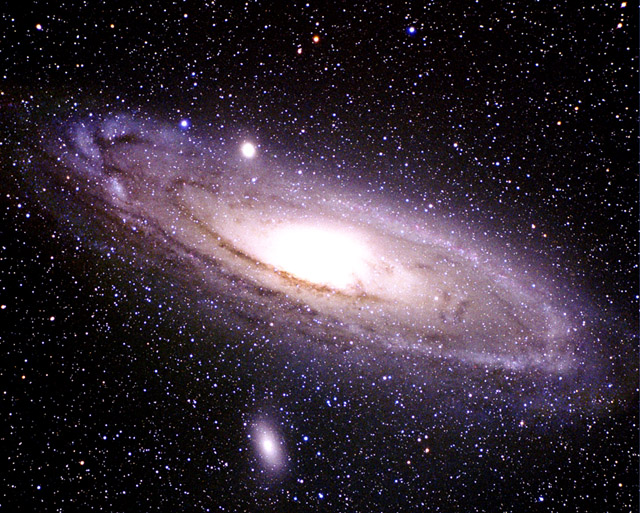
As a kid, I have memories of playing this and kicking *ss. I also recall my poor mom, who apparently had zero knack for this one (but don't tempt her with a game of Trivial Pursuit) and would constantly lose. As in she could not win. Ever. So she never played again.

Anyways, thought this was fun. If only one of the playing pieces was the JWST (especially since it looks so rad) ...

Saturday, September 5, 2009

a phrygian sky.

The moonlight it was dancing on the waves out on the sea
The stars of heaven hovered in a shimmering galaxy

Monday, July 6, 2009

the next giant leap.

From an article in July's GQ ~
[At this moment, NASA] is engaged in work that can be more enduring and far-reaching than anything else this country is paying for. At NASA's inception the government declared that "activities in space should be devoted to peaceful purposes for the benefit of all mankind," and this is one of the few promises in American history that have been kept.

NASA is now fifty. The moonwalk was forty years ago this month. The NASA of yore did the unimaginable in eight years, making good on President Kennedy's assertion that "this nation should commit itself to achieving the goal, before this decade is out, of landing a man on the moon and returning him safely to the earth." It succeeded for two reasons: access to a staggering 4.4 percent of the federal budget (now it's half a percent) and, more importantly, perhaps resurgently, a national desire to believe in ourselves–and in something more than ourselves. Since then, NASA, vision flickering, public imagination uncaptured, has stooped to offering belittling practical justifications for spaceflight (GPS, cell phones) that ground and practicalize the sublime, killing its poetry.

In explaining why space is worth exploring, as NASA frequently finds itself doing, there's a mistaken supposition, because–as with anything of real value–the benefits are largely unknown. It's a philosophical matter, almost religious in its insolubility. Why do we need to love or live at all? The answer is in wondering. And NASA is all about wonder.
As is space. As is space. The author then goes on to say ~
Direction doesn't matter when you're weightless. Up and down are no longer markers. I suddenly understood how in space there is only everywhere. And this revelation was accompanied by the fleeting physical knowledge of what it was to leave the earth. I could move in any direction. All was calm and effortless. And to an astonishing degree–astonishing largely because the understanding was so matter-of-fact–this sort of comfort with wonder felt like the goal of both science and spirituality.

Saturday, April 11, 2009

the origin of the universe.

Beautiful are the things we see
More beautiful those we understand
Much the most beautiful those we do not comprehend.
~ Nicolas Steno, 1638-1686

a slight farewell.


On a walk last evening a bit after sunset, before the clouds closed in and I could still see the western sky, I saw Orion lying low near the horizon about to set and with this song on headphones gave him my own farewell until next autumn when skies grow paler and the weather turns cold.

I am of course excited for Spring and climbing and working outside on my house and summer evenings sitting on my porch after long days summer breezes getting out to the mountains to places I have never been and also to places I have visited and seem like home and flipflops cotton shorts and shirtsleeves windows down in the car and windows open in the house as the neighborhood quiets down and watching the various bulbs I planted last autumn bloom and surprise me as I have forgotten what I have all planted and biking to work and from work especially in the afternoon when it is nice and warm out and longer days and lying in the grass after a particularly good run and perhaps garage sales and swimming in mountain lakes always freezing cold but refreshing more than almost anything and wearing sunglasses and Simply Lemonade in iced mugs straight out of the freezer maybe a good cliff somewhere for jumping from and working on the inside of my house real honest work that makes me sweat and swear but is satisfying all the same and other things maybe that will be unexpected or that I just cannot think of at the moment that makes the warmer months of the year perfect and what they are and by the time they begin to chill off I will be ready to again say hello to my friend in the sky.

So farewell for now in case I do not see you again until October ....

Thursday, March 26, 2009

heaven and hell.

This is the music by the Greek composer Vangelis that Carl Sagan chose as the theme music to his PBS series Cosmos, here set to iTunes' visualizer sequence.


I have been fascinated by watching these installments, courtesy of Netflix. Tonight's was about time travel, the theory of relativity and how light bends and time decays near the speed of light (and props to J for getting through all of it this time without stating to me "too many facts, Dad!").

Absolutely incredible, even if I still have a difficult time wrapping my head around those ideas, and the idea of wormholes and the possibility that the laws of physics (admittedly, as we know them to be up until now) might allow space and time to be non-simply connected (also known as "multiply connected," depicted by the diagram above) as Sagan postulated in his novel Cosmos.

In preparation for that book, he consulted with a friend from Cal Tech named Kip Thorne – a leading and world-renowned theoretical physicist – who initially dismissed the idea of wormholes, but later had an epiphany that they could in fact be used as time machines and ended up publishing a thesis entitled Wormholes, Time Machines and the Weak Energy Condition (it is, I should note, highly speculative at this time).

I still have to read Sagan's novel, and I am all set to watch the movie adaptation again. And we still have three more discs of Cosmos in our Netflix queue. And additionally, Stephen Spielberg is set to release a film called Interstellar that is based on Thorne's theories of time travel through wormholes (though a release date is not given).

Thursday, March 19, 2009

globe at night.

So, ever since coming across the Astronomy Pic of the Day site, it has become J's and my tradition to look at it every day. I let him read it which gives him a nice challenge with a lot of the astronomical words (haha, thank you very much – and I also showed him the option--D shortcut while hovering over a word which will pop up a dictionary with the definition, which he does with some fascination). We have learned some amazing things, but I thought I would share this particular one from today's post:

Explanation:
How many stars can you see? Through next week, the GLOBE at Night project invites people from all over the world to go outside at night, look up, and see!

Specifically, people are invited to go out an hour after sunset and look for the constellation Orion toward the west. Rather than count Orion's stars directly, however, the GLOBE at Night website has made things easier by providing several star charts to which you can compare your view of Orion.

Possible matches extend from a bright sky where only a few Orion stars are visible, to a very dark sky where over 100 Orion stars are visible.

These are results from last year's sky observation campaign. Since 2009 is the International Year of Astronomy (bet you didn't know that!), it is hoped that an even better map can be created this year. By participating in this easy and fun activity, you are helping humanity to better understand how light pollution is changing across the Earth.

So we of course did this, and have ascertained that where we live on a clear night we are about a magnitude 5 (as in, we can see the three stars of Orion's belt - including of course the Orion Nebula - but not quite as many other stars the magnitude 5 chart depicts). And another interesting bit I did not know is that apparently Orion's belt points towards Taurus (and the Pleiades).

It also of course made me wish I could be somewhere again with a magnitude 7 view.

Sunday, March 8, 2009

astronomy images.

After reading this month's Discover article about the violent birth of stars (which featured, of course, the Orion Nebula, along with the other notorious nebula Eagle which contains one of the most famous star-forming regions known as the Pillars of Creation), I somehow wound up on this site, which features astronomy pics updated daily. Upon a quick scroll, it would seem it has a photo for every day from today back through 1995. I have been excitedly clicking/downloading/creating folder for my screensaver of various incredible images. Um, wow.

The image above that I discovered is of course Saturn, but unique in the fact it was taken by Cassini after finding itself in the giant planet's shadow, looking back at the eclipsed sun. This is perhaps now the most incredible image I have ever seen (though this standing will likely change soon the more I scroll through these archives, but really, this is quite amazing). This is a view like no other. First, the night side of Saturn is seen to be partly lit by light reflected from its own majestic ring system. Next, the rings themselves appear dark when silhouetted against the planet, but quite bright when viewed lighted from behind by slightly scattering sunlight. Saturn's rings light up so much that new rings were discovered, although they are hard to see in the above image. Visible in spectacular detail, however, is Saturn's E ring, the ring created by the newly discovered ice-fountains of the moon Enceladus, and the outermost ring visible above.

Perhaps most significant (albeit maybe just to me) is that – far in the distance, visible on the image left just above the bright main rings – is the almost ignorable pale blue dot of Earth.

Thursday, February 26, 2009

orion nebula.

It is difficult for my humble imagination to even believe this exists. This is the Orion Nebula – or M42 – one of the most dramatic, studied and photographed objects in the night sky. It can be seen with the naked eye as the star in the middle of Orion's sword (the three stars located below Orion's belt). With a decent pair of binoculars or a telescope, the nebula can more clearly be seen (as opposed to being just a fuzzy dot to the unaided eye).
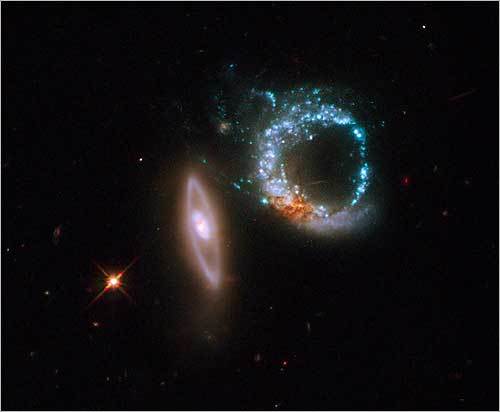
This image is a composite of fifteen images taken by the Hubble Space Telescope in 1995, and is one of the most detailed astronomical images ever captured. At one point I felt my insignificance climbing mountains. This is on an entirely different, much larger and difficult to comprehend scale of which I am still and will always be processing.

Monday, December 15, 2008

desktop.

My new desktop, courtesy of Nasa images. There are millions in which to choose. I have assembled my own screensavers as well.

Thursday, November 13, 2008

hr8799.

From the W.M. Keck Observatory site tonight ~
ASTRONOMERS CAPTURE FIRST IMAGES OF NEWLY-DISCOVERED SOLAR SYSTEM

Kamuela, HI (November 13th, 2008) Using high-contrast, near-infrared adaptive optics observations with the Keck and Gemini telescopes atop Mauna Kea, astronomers for the first time have taken snapshots of a multi-planet solar system, much like ours, orbiting another star.

The new solar system orbits the dusty young star named HR8799, which is 140 light years away and about 1.5 times the size of our sun. Three planets, roughly 10, 10 and 7 times the mass of Jupiter, orbit the star. The sizes of the planets decrease with distance from the parent star, much like the giant planets do in our system.

And there may be more planets out there that scientists just haven't seen yet.
Astronomers have known for over a decade that there are planets orbiting other stars by watching the light output of certain stars – when they would briefly dim, it was supposed the reason was because a planet or other orbiting object had just passed in between it and us. In some ways, planetary system HR8799 seems to be a scaled-up version of our own solar system orbiting a larger and brighter star. The host star is a bright blue A-type star, which is also young – less than 100 million years old. This means its planets are still glowing with heat from their formation.

The planets have been extensively studied using adaptive optics on the giant Keck and Gemini telescopes in Hawaii (the one place in Hawaii that I would have loved to visit but only glimpsed high up on the summit of Mauna Kea from back down by the ocean at Waikoloa). Adaptive optics on these enormous telescopes (the largest ground-based telescopes in the world) enable astronomers to minimize the blurring effects of the Earth's atmosphere and produce images with unprecedented detail and resolution. An advanced computer processing technique is then used to extract detail from the dim planets orbiting this vastly brighter star HR8799. What is so amazing about this optical system is that it was conceived back in 1953 but could not be realized until the 1990s when computer technology had finally caught up to the human mind that envisioned it.

There is a high probability that there are more planets in this distant solar system. What is remarkable about this system from others discovered is that its giant planets lie in the outer parts like in our solar system and so it has 'room' for possible smaller, terrestrial planets closer to the star which are still beyond our current ability to see.

As an astronomer on one of the two teams that was able to take the first images says ~
"It's only a matter of time before we get a dot that's blue and Earthlike."
Thursday, November 6, 2008

m31.

So one more post tonight. I think I'll periodically come and write posts on the stars.

So the story goes .... Andromeda was the beautiful daughter of King Cepheus and Queen Cassiopeia (which will be my next post I'm thinking – Cassiopeia) who ruled over the Phoenician kingdom Ethiopia. Andromeda was incredibly vane and boasted of her own beauty (taking after her mother), and because of this the Queen Cassiopeia upset the sea god Poseidon who then sent a sea monster named Cetus to terrorize the shores of Cepheus' kingdom. In order to make peace with Poseidon, the King was forced to sacrifice his daughter by chaining her to rocks at the shore of the sea. But just as Cetus was about to take her into the depths of the sea, the hero Perseus (as in, the one who slayed Medusa) happened by and killed Cetus. He later wed Andromeda.

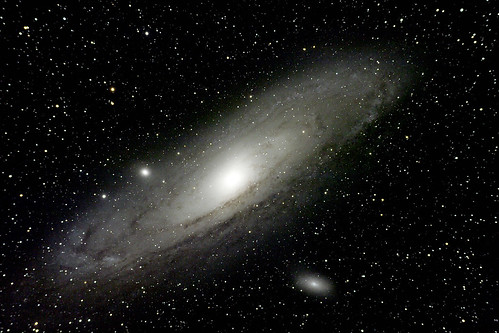
The Andromeda galaxy is a spiral galaxy, one of the showpiece objects of the northern heavens. It is indeed like our own, though much larger (roughly 150,000 light years in diameter). I find myself fascinated by the mythology of the stars, and Andromeda is a beautiful word that Michael Cretu references periodically in his songs. It is linked in the sky to the constellation Pegasus, and the leading star Alpha Andromedae forms the northeastern corner of the Square of Pegasus.

I am going to continue to read about the stars and being fascinated by their presence and their mysteries.