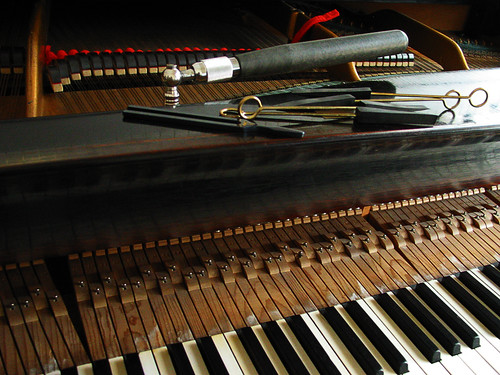
I used to struggle with the idea of perfection. I am an über-perfectionist and was always proud of this fact. Everything needed to be perfect or it was worthless. Everyone needed to be perfect or in them I would hold no interest. I set impossibly high expectations for everything in which I surrounded myself. It was an odd predicament for which I set myself up given the fact I knew, well, I was not perfect. But I could not accept compromises in any form.
Until I listened to an old vinyl recording I picked up I do not know where and do not know when of Wilhelm Backhaus performing three of L.v.Beethoven's most powerful sonatas for piano. I do not recall which piece he was performing when I noticed through the headphones I was wearing that his piano was slightly out of tune. And his phrasing was slightly off. Granted, ever so slightly. But off. Imperfect. But it was brilliant. It was perfect.
And that was it. The spell was broken.
Since that moment some evening years ago, I have become aware of many instances where imperfection is perfect and necessary and I am reminded of this as I work through tuning the Bechstein. The entire basis of the modern method for tuning a piano relies on imperfection. Mathematically a piano cannot be tuned perfectly. Well it can, but only to one key (well, actually several but I will try to keep this thought simple without totally getting into the mechanics of acoustic theory). There must be a compromise in order to play the twelve minor and twelve major keys we have so cunningly devised.
Along these lines Plutarch wrote ~
"Music, to create harmony, must investigate discord."
I have numerous texts on the subject of tuning and what we call temperament including a perfectly old text published in 1946 simply titled Piano Tuning and Allied Arts. It is as fascinating as the stars. How the art of tuning a piano (and yes, it truly is an art) is as I tend to find the most appealing a merging of science and art. It is incredibly mathematical in its design, but what lies at the heart of being able to carry out is the human element of hearing the waves of sound the beats and pulses of two notes set against each other and the timings and from those pulses to determine the correct temperament (most recognizable in the octave, unison and fifth) caused by the waves in the defective pair alternating recurring periods when the condensations and rarefactions antagonize one another. In other words – or word, as it is called in physics – interference. It requires a clear understanding of harmony, the natural and artificial phenomena of musical tones and how they relate to each other through intervals and those specific relations. It is mesmerizing.
The term temperament means quite literally "a system of compromises in the tuning of pianofortes." Compromises. Imperfections. Both necessary in order to achieve a balance – that being able to play in all twelve major and minor keys (the pianist David Helfgott's professor told him quite assuredly that "it is all a question of balance"). There are two principal temperaments in our twelve-step musical intonation – mean-tone and equal. Mean-tone temperament was used primarily before 1700 and intervals like the fifth and literally every step of a scale were tuned perfectly. This sounds wonderful, but physics complicates the matter (bother logarithms) and music written in one key could not be transposed to another without certain intervals sounding atrocious (due to the complications of a vibrating string's overtones). It was around 1691 that Andreas Werckmeister theorized a series of tunings where enharmonic notes had the same pitch in such that the same note was used as both (for example E♭ and D♯), thereby bringing the pianoforte into the form of a circle. This refers to the fact that the notes or keys may be arranged in a circle of fifths (anyone who has taken even an elementary music theory course will recognize this term) and it is possible to modulate from one key to another unrestrictedly. It was quite brilliant and formed the basis of the modern tuning system.
But how it works is simple and complex – the fifth is tuned perfect .... then flattened slightly. The complication of course is in how much. In a true equal-tempered scale, all half-steps are tuned equally and thus no two fifths will beat exactly alike because the lower the fifth, the slower it should beat while those in the treble are meant to beat faster, for if all fifths were tuned perfect we would end up being unable to transpose our music (the physics is quite complex and I will refrain from elaborating). There are a number of different tests the tuner performs while setting the temperament to check this flattening of fifths (listening to other intervals – the perfect thirds, the major sixths and so on).
I have known people who have replaced their pianos with electronic keyboards for ease of use – the electronic version never needs to be tuned (or – with the aid of a sequencer – can be tuned to any number of different tuning systems). Electronic music can also be quantized (in software like ProTools or Logic, for example) which is simply a method of aligning notes to a mathematical grid so-to-speak so that each note is perfectly in time – rounded to a degree of precision up to 0.00390625 (1/256th). I propose that had Backhaus' performance of Beethoven been quantized, all feeling would have been lost. For this very reason and for what I find slightly ironic is the fact that in Logic Pro (and no doubt other digital workstations) a parameter called Q-swing can be introduced which – in the case of Logic – varies the position of every second beat giving a purely quantized performance a more, well, un-quantized feel. A certain air of imperfection, in other words.
Once this idea is accepted the examples of necessary imperfection set against perfection in order to achieve balance are everywhere but – and this is key – they are all analog (or one could use the term 'organic'). Backhaus' playing. Equal-tempered tuning. Film grain. The ability of analog tape to absorb excessive electrical impulses before clipping the signals (a form of acoustic saturation, known affectionately as tape saturation). In an analog world and with analog devices, imperfection can be achieved to balance perfection. In digital and all of its binary code, there is no imperfection.
Although inextricably linked to this topic, I wish to avoid the clichéd argument of analog vs. digital (at least for now) and instead adhere to simply throwing out the idea of the necessity of imperfections all around us which allow for us to feel a connection – be it to a musical performance, Nature, those people we choose to identify with and so on.
Or just a slightly out-of-tune, mis-timed performance of a Beethoven sonata on a Bechstein grand by an aging genius named Wilhelm Backhaus.