Monday, March 30, 2009

banter.

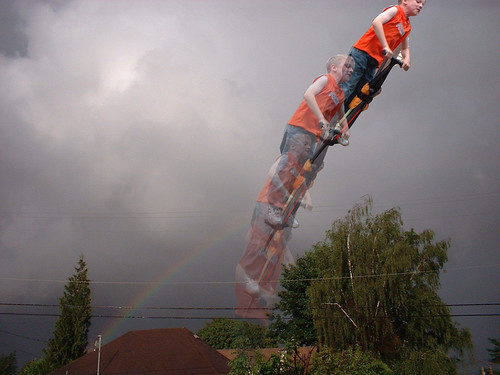
Springing Into the Air, originally uploaded by superhiker (uh, that would be my kid)

OK, so for a little light-hearted banter because a) I am pretty flippin' impressed and b) it is pretty flippin' hilarious (at least to me) ...

So, Saturday morning we woke up and before even getting out of bed I was showing J how to use the brush to mask things in Photoshop. It was at about the five minute mark he gave me the ol' 'OK, Dad, I get it' and went off to his room where he proceeded to spend a good bit of the weekend surprising me with his imagination, creativity, apparent Photoshop wizardry (I've known supposed retouching pros who cannot composite this well) and downright resourcefulness with a slew of images he quickly posted to his Flickr stream.

This one was one of the most impressive (or certainly one of the most amusing). I must say I took no part in this – this is all him. I don't even know where he found the shot of him pogo-sticking, but apparently one exists; or where he got the idea for this composite. I about rolled off the kitchen chair when I saw the thumbnail.

Props to my kid.

escape velocity [recorded].

Well, finally, just the idea of it. Hammered away on the Bechstein, then back to the keyboard (still need an interface and a pair of mics to record the piano for real) to lay it out. Know exactly what I want to say but unable yet to really say it. Julian came by wondering what I was up to, so I showed him around Logic a bit – creating objects, sends and effects. Editing a few mis-played notes. Adjusting levels and so on. He looked at me and said when I get everything together it is going to be awesome. I guess I am on the right track.

The more I listen to the playback and play it myself (different still every time as I have yet to really nail down how exactly it goes) and the more I read about the Apollo missions and the Voyager missions I get this enormous sense of optimism that cannot be contained and I want to find a way to put that into lyrics for music that is huge and larger than almost anything I have ever written trying to make the analogy to our ever-so-short-lived quest – triumphs and tragedies and all – to reach the stars. The idea of hope beckons with this image in my mind of an enormous Saturn V rocket – a triumph of the humankind – lifting off and in an instant out of sight, hurtling away from Earth and everything we know out into a vastness we cannot comprehend, but with so much promise and mystery.

I have tried in the past (feebly at best) to describe places here on Earth through which I have traveled and become a part of if even short-lived, but it is that much more difficult I am finding to write about experiences I cannot imagine – of looking back at this tiny world on which we find ourselves for now from an unimaginable distance in some attempt to understand our fragility, our isolation and loneliness, our dependence on one another, our need to respect all that we have. It is quite simple to say, on one hand, how this fascination of mine with the stars and my zealousness to study them and the sciences to which they relate has given me this notion that we can indeed overcome our odds and prove our potential to all those generations before us and all those yet to come. Impossible on the other to find a way to say how.

Maybe I should just leave it at that for now. Try to get some sleep. Think about it some more. Maybe one day I will be able to write what I want to say.

Saturday, March 28, 2009

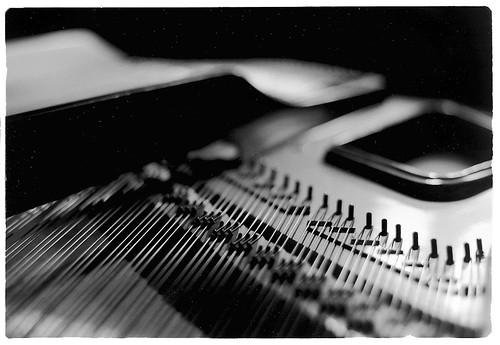
the bechstein.

There really is no better sound in this world (other than perhaps none at all, as in complete silence found only while high up in the mountains far removed from everything) than a just-tuned piano. Without the cancellations of duplexed and triplexed strings beating out of sync, the piano gains enormous volume – nearly too much for this little living room in which I find myself this afternoon. It has a certain power to it that it does not have at any other time, and a perfection in its imperfections. Made especially clear because of the routine of tuning, where you of course only tune one note per string at a time, and get quite used to the rather lackluster sound that creates. But then, once having finished all the keys, the task begins of tuning the unisons – over two hundred of them in all – and the sound begins to take shape.

After all too much time spent on keyboards in Logic, the inexplicable acoustic power of this hundred-and-thirty-nine-year-old German grand piano, strings copper wound by now-antiquated machines and hammers voiced by delicate hands nearly a century-and-a-half ago, the soundwaves upon soundwaves multiplying on top of each other until nearly exploding, is just an absolutely phenomenal sensation to behold.

I love acoustics.

Thursday, March 26, 2009

heaven and hell.

This is the music by the Greek composer Vangelis that Carl Sagan chose as the theme music to his PBS series Cosmos, here set to iTunes' visualizer sequence.


I have been fascinated by watching these installments, courtesy of Netflix. Tonight's was about time travel, the theory of relativity and how light bends and time decays near the speed of light (and props to J for getting through all of it this time without stating to me "too many facts, Dad!").

Absolutely incredible, even if I still have a difficult time wrapping my head around those ideas, and the idea of wormholes and the possibility that the laws of physics (admittedly, as we know them to be up until now) might allow space and time to be non-simply connected (also known as "multiply connected," depicted by the diagram above) as Sagan postulated in his novel Cosmos.

In preparation for that book, he consulted with a friend from Cal Tech named Kip Thorne – a leading and world-renowned theoretical physicist – who initially dismissed the idea of wormholes, but later had an epiphany that they could in fact be used as time machines and ended up publishing a thesis entitled Wormholes, Time Machines and the Weak Energy Condition (it is, I should note, highly speculative at this time).

I still have to read Sagan's novel, and I am all set to watch the movie adaptation again. And we still have three more discs of Cosmos in our Netflix queue. And additionally, Stephen Spielberg is set to release a film called Interstellar that is based on Thorne's theories of time travel through wormholes (though a release date is not given).

Tuesday, March 24, 2009

time stands still.

And then it hit me. I had come up with the melody of the verses for this song years ago but it had a very dour lyrical approach which I wanted to revisit and rewrite completely new but out of nowhere the melody hit me tonight and then as I went over it in my head I came up with the chorus which sent me rushing to the little corner in my living room to fire up my Mac and get this idea on tape (or, in this case, hard disk) before it escaped me for another couple of years. It is like everything driven by a very heavy, dense piano line and is a song as I hear it still in my head that builds and builds until it reaches the first chorus, then keeps that level but builds more upon the second chorus, then keeps that, then crescendos unbelievably with the third chorus and the end. This is incredible and a song that over the course of roughly fifteen minutes went from an age-old idea in my head to something of substantial worth that will be developed at all costs! Lyrics are lame at the moment but trying to wrap my head around what it is I want to write hopefully ambiguous of course and then will figure out how to write it. The idea is what I will fall asleep with in my head tonight, better that than this pounding music.
And time stands still
Must all be veiled? Unseen?
Where "and time stands still" starts out on the third of a C♯ minor, then rises to an E major then a B major then a G♯ minor with an enormous crescendo at "unseen" but rising still higher to end back on a C♯ minor an octave-and-a-half above and at least a few dynamic markings higher than where the phrase started and then an enormous ending and silence and in fact the whole song is hugely-intense and very heavy-sounding with quite phenomenal and enormously difficult guitar and piano lines. But regardless, it will be something else entirely to find someone who can sing this that I hear in my head.

Saturday, March 21, 2009

Thursday, March 19, 2009

globe at night.

So, ever since coming across the Astronomy Pic of the Day site, it has become J's and my tradition to look at it every day. I let him read it which gives him a nice challenge with a lot of the astronomical words (haha, thank you very much – and I also showed him the option--D shortcut while hovering over a word which will pop up a dictionary with the definition, which he does with some fascination). We have learned some amazing things, but I thought I would share this particular one from today's post:

Explanation:
How many stars can you see? Through next week, the GLOBE at Night project invites people from all over the world to go outside at night, look up, and see!

Specifically, people are invited to go out an hour after sunset and look for the constellation Orion toward the west. Rather than count Orion's stars directly, however, the GLOBE at Night website has made things easier by providing several star charts to which you can compare your view of Orion.

Possible matches extend from a bright sky where only a few Orion stars are visible, to a very dark sky where over 100 Orion stars are visible.

These are results from last year's sky observation campaign. Since 2009 is the International Year of Astronomy (bet you didn't know that!), it is hoped that an even better map can be created this year. By participating in this easy and fun activity, you are helping humanity to better understand how light pollution is changing across the Earth.

So we of course did this, and have ascertained that where we live on a clear night we are about a magnitude 5 (as in, we can see the three stars of Orion's belt - including of course the Orion Nebula - but not quite as many other stars the magnitude 5 chart depicts). And another interesting bit I did not know is that apparently Orion's belt points towards Taurus (and the Pleiades).

It also of course made me wish I could be somewhere again with a magnitude 7 view.